What is the reputation gap?

Katie Moran

Katie Moran

10 November 2026

What's this about?

When a business changes, the market's view of it lags behind. This piece explains why that reputation gap exists, how to close it, and includes a simple three-column worksheet to find your own.
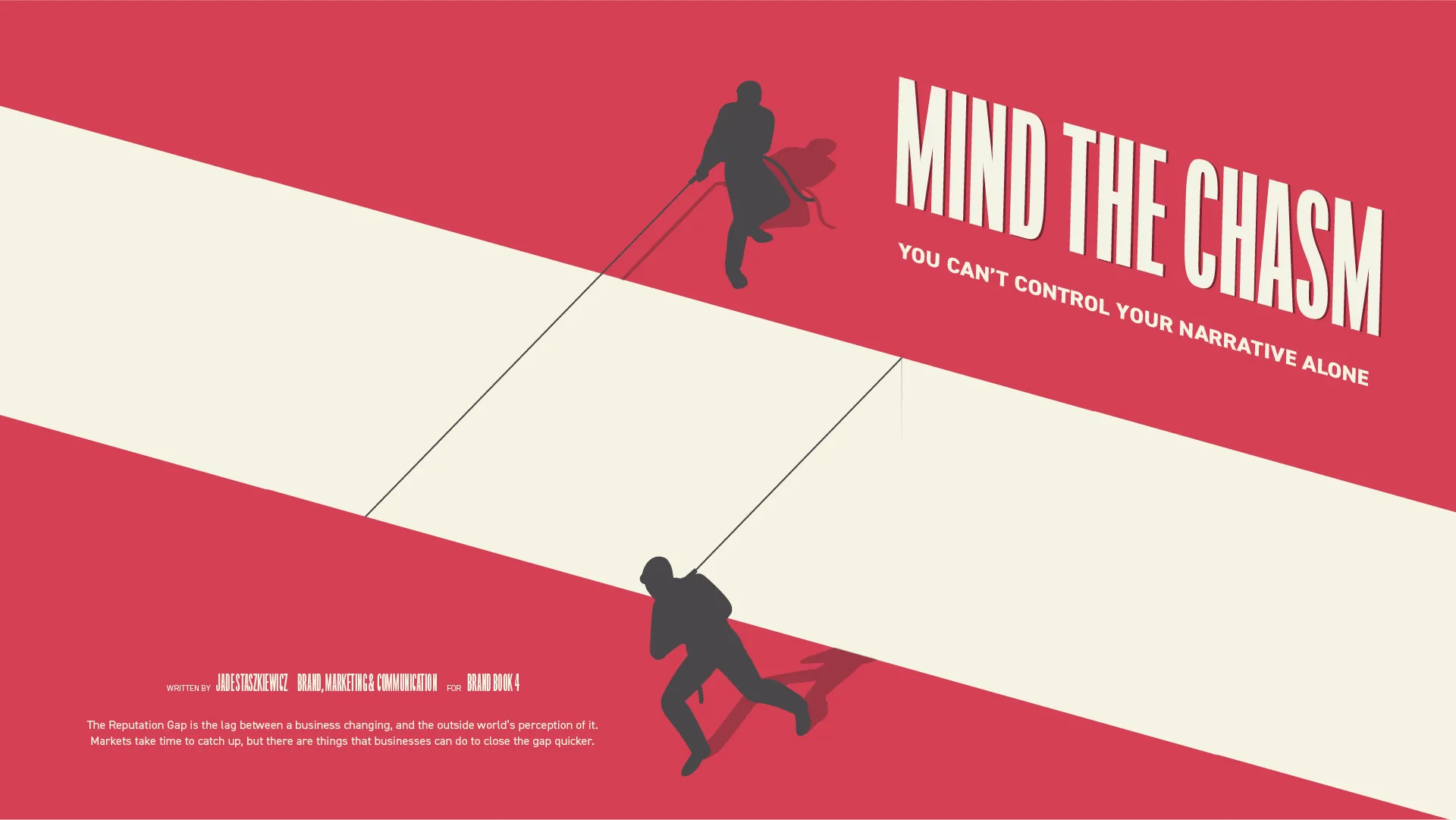
Businesses are in a constant state of change: new leadership, new service lines, an acquisition, new products, going public. Many announce the change and move on, assuming everyone else has moved on with them. In reality, market understanding moves at a much slower pace.

That lag between a business changing and the outside world's perception of it is what we call the reputation gap.

Visible changes, such as a product update or rebrand, are reflected in perception faster than internal ones, such as new processes or culture. Either way, changing someone's view takes time and persistence.

How long does it take to change perception?

There's no research that gives a reliable timeframe. Perception is hard to measure, much like brand in general (which is why we built our own brand measurement framework). What we see in practice:

  • Perception shifts faster among employees, suppliers and customers, and more slowly in the wider market.
  • It depends on what's changed. Recovering from a crisis takes far longer than a product change.
  • Above all, it comes down to how clearly the change is communicated, and how fully the whole organisation embraces the new story.

Why does the gap exist?

  • People hold on to the version of you they already know.
  • Staff who don't believe in the change can't sell it to anyone else.
  • One announcement doesn't move perception. People need to see a new message several times before it registers, and many more before they believe it.
  • Businesses often announce change before they've demonstrated it. Audiences want proof, not promises.
  • You can't control your narrative alone. Until press, peers, industry voices and customers reflect your change back, the wider market won't believe it.
  • Your old footprint keeps working against you. Past reviews, legacy content and outdated listings shape perception long after you've moved on.

How to close the gap

  1. Check your brand is aligned with who you are right now. (Here’s how ITM Power evolved its brand without losing the trust it had built.)
  2. Audit your legacy footprint and remove anything outdated or contradictory.
  3. Align your teams internally before sharing anything externally.
  4. Encourage others to communicate your new story for you.
  5. Be consistently visible across multiple touchpoints.
  6. Shift the perceptions of your highest-value or most influential audiences first.
  7. Demonstrate the change; don't just talk about it.
  8. Measure before and after, and keep measuring.

Some lag is inevitable. The worst thing you can do is sit and wait for the market to catch up.

Worksheet: what's your reputation gap?

Fill in three columns honestly:

  1. How we see ourselves
  2. How the market sees us
  3. How we want to be seen
  • The gap between 1 and 2 is your reputation gap. Ask why it exists and what you can do to close it.
  • If the biggest gap is between 1 and 3, focus on internal alignment and build the reputation you want from the inside out.
  • If the biggest gap is between 2 and 3, focus on your brand and external communications, with consistent messaging, visuals and action.

Download the free reputation gap worksheet (PDF)

Want to know your gap?

Score your brand or book a Brand Audit.

First published in Brand Book Vol. IV. Read the full edition.

FAQs.

Usually the business has changed faster than its communications, or different teams and channels are telling different stories. An outdated digital footprint also keeps the old perception alive.

Through stakeholder interviews, customer and employee surveys, search and social analysis, and frameworks like our Brand-360 score, measured before and after a change.

There’s no fixed timeframe. Employees, customers and suppliers usually catch up first, and the wider market last. How fast it happens depends on how clearly the change is communicated, how consistently it shows up across every touchpoint, and whether you can prove it rather than just announce it.

IV

Shades of Change:

Fear or Opportunity?